what is segment, packets, frames, and bits? how to correlate the osi model? quizlet

This article explains the Open up Systems Interconnection (OSI) model and the vii layers of networking, in evidently English.
The OSI model is a conceptual framework that is used to describe how a network functions. In plain English, the OSI model helped standardize the way computer systems send information to each other.
Learning networking is a bit similar learning a language - in that location are lots of standards and and then some exceptions. Therefore, it's of import to really understand that the OSI model is non a set of rules. It is a tool for understanding how networks function.
In one case you acquire the OSI model, you will be able to further empathize and capeesh this glorious entity we call the Internet, as well as be able to troubleshoot networking bug with greater fluency and ease.
All hail the Internet!
Prerequisites
You don't need any prior programming or networking feel to understand this article. However, you will need:
- Basic familiarity with common networking terms (explained below)
- A marvel about how things work :)
Learning Objectives
Over the course of this article, y'all volition learn:
- What the OSI model is
- The purpose of each of the 7 layers
- The problems that can happen at each of the 7 layers
- The difference betwixt TCP/IP model and the OSI model
Common Networking Terms
Here are some mutual networking terms that yous should be familiar with to become the most out of this article. I'll use these terms when I talk about OSI layers next.
Nodes
A node is a concrete electronic device hooked upwards to a network, for example a computer, printer, router, and so on. If fix properly, a node is capable of sending and/or receiving data over a network.
Nodes may be ready up adjacent to ane other, wherein Node A can connect direct to Node B, or there may be an intermediate node, similar a switch or a router, set up between Node A and Node B.
Typically, routers connect networks to the Internet and switches operate within a network to facilitate intra-network communication. Learn more about hub vs. switch vs. router.
Here's an example:
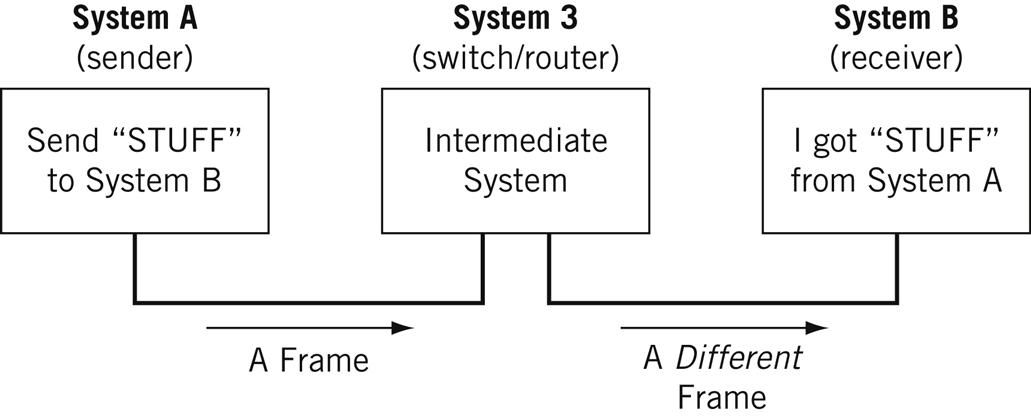
For the nitpicky among us (yep, I see you), host is some other term that you lot will run into in networking. I will define a host as a type of node that requires an IP accost. All hosts are nodes, just non all nodes are hosts. Please Tweet angrily at me if you disagree.
Links
Links connect nodes on a network. Links can be wired, like Ethernet, or cable-free, like WiFi.
Links to can either be betoken-to-point, where Node A is connected to Node B, or multipoint, where Node A is connected to Node B and Node C.
When nosotros're talking almost information being transmitted, this may too be described equally a i-to-one vs. a one-to-many human relationship.
Protocol
A protocol is a mutually agreed upon prepare of rules that allows two nodes on a network to commutation data.
"A protocol defines the rules governing the syntax (what tin be communicated), semantics (how information technology can be communicated), and synchronization (when and at what speed it can be communicated) of the communications procedure. Protocols can exist implemented on hardware, software, or a combination of both. Protocols can be created by anyone, but the almost widely adopted protocols are based on standards." - The Illustrated Network.
Both wired and cablevision-free links tin can take protocols.
While anyone tin can create a protocol, the near widely adopted protocols are often based on standards published by Cyberspace organizations such as the Internet Engineering Task Force (IETF).
Networks
A network is a general term for a group of computers, printers, or any other device that wants to share data.
Network types include LAN, HAN, Tin can, Homo, WAN, BAN, or VPN. Think I'thou just randomly rhyming things with the give-and-take can? I can't say I am - these are all real network types. Learn more here.
Topology
Topology describes how nodes and links fit together in a network configuration, often depicted in a diagram. Here are some common network topology types:
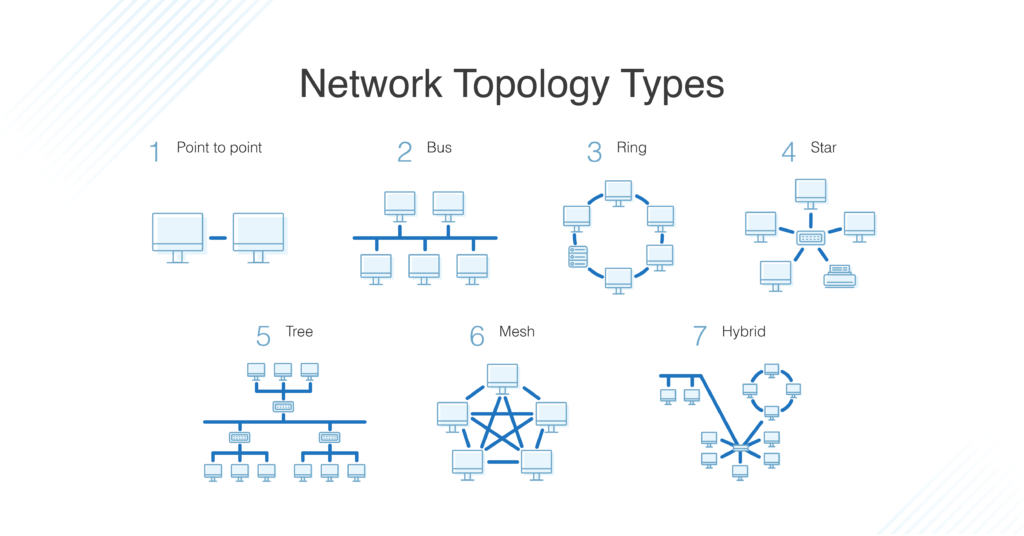
A network consists of nodes, links between nodes, and protocols that govern data transmission between nodes.
At whatsoever scale and complication networks get to, you volition understand what's happening in all computer networks by learning the OSI model and 7 layers of networking.
What is the OSI Model?
The OSI model consists of vii layers of networking.
First, what's a layer?
Ooo, lair.
No, a layer - non a lair. Here in that location are no dragons.
A layer is a way of categorizing and grouping functionality and behavior on and of a network.
In the OSI model, layers are organized from the nearly tangible and most physical, to less tangible and less physical merely closer to the cease user.
Each layer abstracts lower level functionality away until by the time you get to the highest layer. All the details and inner workings of all the other layers are hidden from the stop user.
How to call back all the names of the layers? Easy.
- Please | Physical Layer
- Practice | Data Link Layer
- Not | Network Layer
- Tell (the) | Transport Layer
- Secret | Session Layer
- Countersign (to) | Presentation Layer
- Anyone | Application Layer
Go on in heed that while certain technologies, like protocols, may logically "belong to" one layer more than than another, not all technologies fit neatly into a single layer in the OSI model. For example, Ethernet, 802.11 (Wifi) and the Address Resolution Protocol (ARP) procedure operate on >one layer.
The OSI is a model and a tool, not a set up of rules.
OSI Layer 1
Layer 1 is the physical layer. In that location'southward a lot of technology in Layer 1 - everything from physical network devices, cabling, to how the cables hook upwardly to the devices. Plus if we don't need cables, what the betoken type and manual methods are (for example, wireless broadband).
Instead of listing every type of technology in Layer 1, I've created broader categories for these technologies. I encourage readers to learn more than about each of these categories:
- Nodes (devices) and networking hardware components. Devices include hubs, repeaters, routers, computers, printers, and so on. Hardware components that live inside of these devices include antennas, amplifiers, Network Interface Cards (NICs), and more.
- Device interface mechanics. How and where does a cablevision connect to a device (cablevision connector and device socket)? What is the size and shape of the connector, and how many pins does it take? What dictates when a pivot is active or inactive?
- Functional and procedural logic. What is the role of each pin in the connector - send or receive? What procedural logic dictates the sequence of events so a node tin start to communicate with another node on Layer ii?
- Cabling protocols and specifications. Ethernet (CAT), USB, Digital Subscriber Line (DSL), and more. Specifications include maximum cable length, modulation techniques, radio specifications, line coding, and $.25 synchronization (more on that below).
- Cable types. Options include shielded or unshielded twisted pair, untwisted pair, coaxial and so on. Learn more about cable types here.
- Indicate type. Baseband is a single flake stream at a time, like a railway track - one-way only. Broadband consists of multiple chip streams at the same fourth dimension, similar a bi-directional highway.
- Signal manual method (may be wired or cable-complimentary). Options include electrical (Ethernet), calorie-free (optical networks, fiber optics), radio waves (802.11 WiFi, a/b/m/northward/ac/ax variants or Bluetooth). If cable-free, then likewise consider frequency: two.5 GHz vs. 5 GHz. If it's cabled, consider voltage. If cabled and Ethernet, also consider networking standards like 100BASE-T and related standards.
The data unit of measurement on Layer 1 is the scrap.
A flake the smallest unit of transmittable digital information. Bits are binary, so either a 0 or a 1. Bytes, consisting of eight $.25, are used to represent unmarried characters, like a letter, numeral, or symbol.
Bits are sent to and from hardware devices in accordance with the supported data rate (transmission rate, in number of bits per 2nd or millisecond) and are synchronized so the number of bits sent and received per unit of measurement of time remains consequent (this is called bit synchronization). The way $.25 are transmitted depends on the point transmission method.
Nodes can send, receive, or send and receive bits. If they can just do one, then the node uses a simplex style. If they can practice both, so the node uses a duplex mode. If a node can send and receive at the same time, it's total-duplex – if non, information technology'due south just half-duplex.
The original Ethernet was half-duplex. Full-duplex Ethernet is an selection now, given the right equipment.
How to Troubleshoot OSI Layer 1 Problems
Hither are some Layer 1 issues to scout out for:
- Defunct cables, for example damaged wires or cleaved connectors
- Broken hardware network devices, for instance damaged circuits
- Stuff being unplugged (...we've all been there)
If there are issues in Layer 1, anything beyond Layer 1 will not function properly.
TL;DR
Layer 1 contains the infrastructure that makes communication on networks possible.
Information technology defines the electrical, mechanical, procedural, and functional specifications for activating, maintaining, and deactivating physical links betwixt network devices. - Source
Fun fact: deep-sea communications cables transmit information around the globe. This map will blow your mind: https://www.submarinecablemap.com/
And because you made it this far, hither's a koala:

OSI Layer 2
Layer two is the data link layer. Layer 2 defines how data is formatted for transmission, how much data tin catamenia between nodes, for how long, and what to do when errors are detected in this flow.
In more official tech terms:
- Line subject area. Who should talk for how long? How long should nodes be able to transit information for?
- Flow command. How much information should exist transmitted?
- Fault control - detection and correction. All data transmission methods have potential for errors, from electrical spikes to dirty connectors. One time Layer two technologies tell network administrators about an issue on Layer 2 or Layer one, the organization administrator tin right for those errors on subsequent layers. Layer 2 is generally concerned with error detection, not mistake correction. (Source)
In that location are two distinct sublayers within Layer 2:
- Media Access Control (MAC): the MAC sublayer handles the assignment of a hardware identification number, chosen a MAC address, that uniquely identifies each device on a network. No two devices should accept the same MAC address. The MAC address is assigned at the bespeak of manufacturing. It is automatically recognized by most networks. MAC addresses alive on Network Interface Cards (NICs). Switches keep track of all MAC addresses on a network. Learn more about MAC addresses on PC Mag and in this article. Learn more almost network switches here.
- Logical Link Control (LLC): the LLC sublayer handles framing addressing and catamenia control. The speed depends on the link between nodes, for example Ethernet or Wifi.
The data unit on Layer two is a frame.
Each frame contains a frame header, body, and a frame trailer:
- Header: typically includes MAC addresses for the source and destination nodes.
- Body: consists of the bits being transmitted.
- Trailer: includes error detection information. When errors are detected, and depending on the implementation or configuration of a network or protocol, frames may be discarded or the error may exist reported upwardly to higher layers for farther error correction. Examples of mistake detection mechanisms: Cyclic Redundancy Check (CRC) and Frame Check Sequence (FCS). Larn more about error detection techniques here.
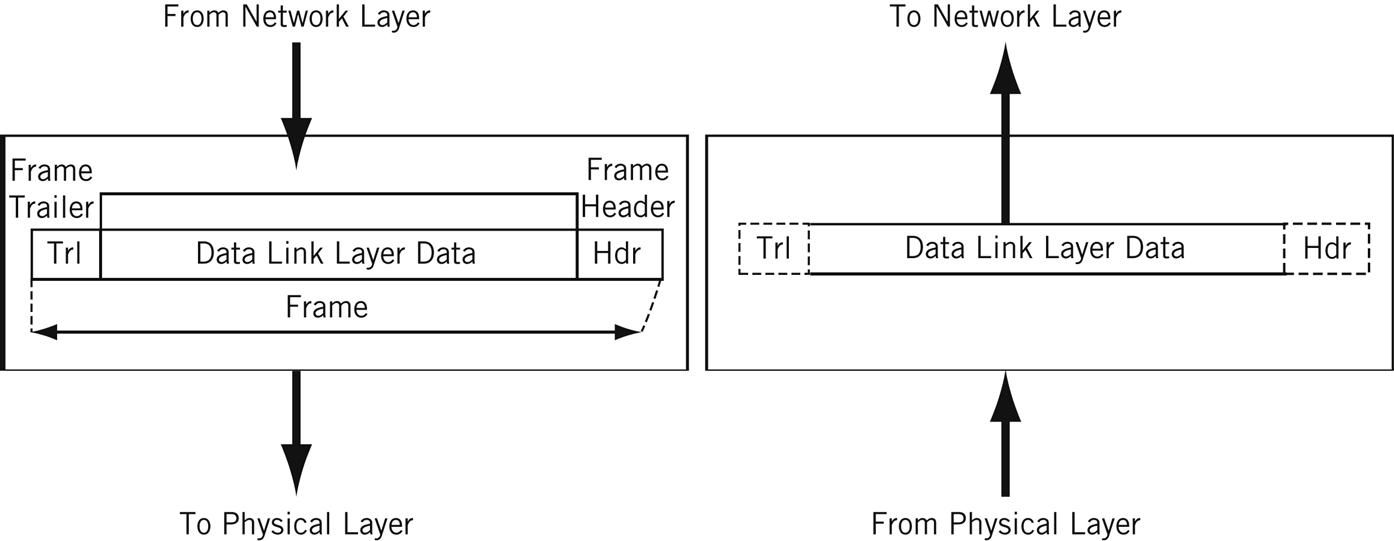
Typically there is a maximum frame size limit, chosen an Maximum Manual Unit, MTU. Jumbo frames exceed the standard MTU, learn more about colossal frames here.
How to Troubleshoot OSI Layer 2 Problems
Hither are some Layer ii problems to sentry out for:
- All the problems that can occur on Layer one
- Unsuccessful connections (sessions) between 2 nodes
- Sessions that are successfully established but intermittently fail
- Frame collisions
TL;DR
The Data Link Layer allows nodes to communicate with each other within a local area network. The foundations of line discipline, flow control, and fault command are established in this layer.
OSI Layer 3
Layer iii is the network layer. This is where we transport information between and across networks through the utilise of routers. Instead of just node-to-node communication, nosotros tin now exercise network-to-network communication.
Routers are the workhorse of Layer iii - nosotros couldn't have Layer 3 without them. They move information packets across multiple networks.
Not but practise they connect to Internet Service Providers (ISPs) to provide access to the Internet, they also keep track of what's on its network (remember that switches keep track of all MAC addresses on a network), what other networks information technology'south connected to, and the different paths for routing data packets beyond these networks.
Routers shop all of this addressing and routing data in routing tables.
Hither'south a simple case of a routing table:
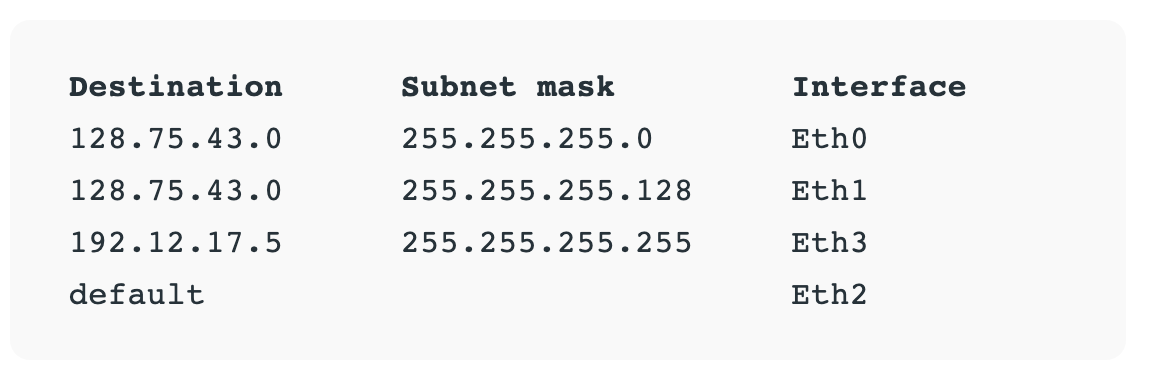
The data unit on Layer 3 is the data packet. Typically, each information package contains a frame plus an IP address information wrapper. In other words, frames are encapsulated by Layer 3 addressing data.
The data beingness transmitted in a packet is also sometimes chosen the payload. While each bundle has everything it needs to get to its destination, whether or not it makes it there is another story.
Layer 3 transmissions are connectionless, or best attempt - they don't do anything just send the traffic where it's supposed to get. More on data send protocols on Layer 4.
In one case a node is connected to the Internet, it is assigned an Internet Protocol (IP) address, which looks either similar 172.16. 254.1 (IPv4 address convention) or similar 2001:0db8:85a3:0000:0000:8a2e:0370:7334 (IPv6 accost convention). Routers utilise IP addresses in their routing tables.
IP addresses are associated with the physical node'due south MAC address via the Accost Resolution Protocol (ARP), which resolves MAC addresses with the node'southward corresponding IP address.
ARP is conventionally considered part of Layer 2, but since IP addresses don't exist until Layer 3, it'due south too part of Layer 3.
How to Troubleshoot OSI Layer 3 Problems
Here are some Layer 3 problems to watch out for:
- All the problems that tin crop upwardly on previous layers :)
- Faulty or non-functional router or other node
- IP accost is incorrectly configured
Many answers to Layer three questions will require the use of control-line tools like ping, trace, show ip route, or evidence ip protocols. Learn more about troubleshooting on layer ane-iii here.
TL;DR
The Network Layer allows nodes to connect to the Internet and send data across different networks.
OSI Layer 4
Layer 4 is the ship layer. This where nosotros swoop into the nitty gritty specifics of the connection between two nodes and how data is transmitted betwixt them. It builds on the functions of Layer 2 - line discipline, flow control, and error control.
This layer is likewise responsible for data packet sectionalisation, or how data packets are broken upward and sent over the network.
Unlike the previous layer, Layer iv also has an agreement of the whole message, not just the contents of each individual data packet. With this agreement, Layer 4 is able to manage network congestion by non sending all the packets at in one case.
The data units of Layer four go by a few names. For TCP, the data unit is a packet. For UDP, a parcel is referred to as a datagram. I'll only use the term data parcel here for the sake of simplicity.
Transmission Control Protocol (TCP) and User Datagram Protocol (UDP) are two of the most well-known protocols in Layer 4.
TCP, a connection-oriented protocol, prioritizes data quality over speed.
TCP explicitly establishes a connexion with the destination node and requires a handshake between the source and destination nodes when data is transmitted. The handshake confirms that data was received. If the destination node does non receive all of the data, TCP will ask for a retry.
TCP also ensures that packets are delivered or reassembled in the right order. Acquire more about TCP here.
UDP, a connectionless protocol, prioritizes speed over data quality. UDP does non require a handshake, which is why it'due south called connectionless.
Because UDP doesn't take to await for this acknowledgement, it can transport information at a faster rate, but not all of the data may be successfully transmitted and we'd never know.
If data is split up into multiple datagrams, unless those datagrams contain a sequence number, UDP does non ensure that packets are reassembled in the correct club. Learn more about UDP here.
TCP and UDP both send data to specific ports on a network device, which has an IP address. The combination of the IP address and the port number is called a socket.
Learn more than about sockets here.
Larn more about the differences and similarities betwixt these two protocols here.
How to Troubleshoot OSI Layer four Problems
Here are some Layer iv problems to watch out for:
- All the problems that tin can crop upwardly on previous layers :)
- Blocked ports - check your Access Control Lists (ACL) & firewalls
- Quality of Service (QoS) settings. QoS is a feature of routers/switches that tin prioritize traffic, and they can really muck things up. Learn more nearly QoS here.
TL;DR
The Transport Layer provides stop-to-end manual of a message by segmenting a message into multiple data packets; the layer supports connection-oriented and connectionless communication.
OSI Layer 5
Layer 5 is the session layer. This layer establishes, maintains, and terminates sessions.
A session is a mutually agreed upon connection that is established between two network applications. Non 2 nodes! Nope, we've moved on from nodes. They were so Layer 4.
Just kidding, we still have nodes, but Layer 5 doesn't need to retain the concept of a node because that's been abstracted out (taken care of) by previous layers.
So a session is a connection that is established between ii specific end-user applications. There are two important concepts to consider here:
- Client and server model: the application requesting the data is called the customer, and the application that has the requested information is called the server.
- Request and response model: while a session is beingness established and during a session, there is a constant back-and-forth of requests for information and responses containing that information or "hey, I don't have what you lot're requesting."
Sessions may be open up for a very short amount of time or a long amount of time. They may fail sometimes, too.
Depending on the protocol in question, various failure resolution processes may boot in. Depending on the applications/protocols/hardware in use, sessions may support simplex, half-duplex, or full-duplex modes.
Examples of protocols on Layer 5 include Network Bones Input Output System (NetBIOS) and Remote Procedure Telephone call Protocol (RPC), and many others.
From here on out (layer 5 and up), networks are focused on ways of making connections to end-user applications and displaying information to the user.
How to Troubleshoot OSI Layer 5 Problems
Here are some Layer 5 problems to watch out for:
- Servers are unavailable
- Servers are incorrectly configured, for instance Apache or PHP configs
- Session failure - disconnect, timeout, and then on.
TL;DR
The Session Layer initiates, maintains, and terminates connections between 2 end-user applications. It responds to requests from the presentation layer and issues requests to the transport layer.
OSI Layer 6
Layer 6 is the presentation layer. This layer is responsible for data formatting, such every bit graphic symbol encoding and conversions, and data encryption.
The operating arrangement that hosts the stop-user awarding is typically involved in Layer half-dozen processes. This functionality is not always implemented in a network protocol.
Layer half dozen makes certain that stop-user applications operating on Layer 7 can successfully eat information and, of course, eventually display it.
There are three data formatting methods to be enlightened of:
- American Standard Code for Information Interchange (ASCII): this 7-bit encoding technique is the most widely used standard for graphic symbol encoding. I superset is ISO-8859-1, which provides nearly of the characters necessary for languages spoken in Western Europe.
- Extended Binary-Coded Decimal Interchange Code (EBDCIC): designed by IBM for mainframe usage. This encoding is incompatible with other character encoding methods.
- Unicode: graphic symbol encodings tin can exist done with 32-, sixteen-, or viii-bit characters and attempts to adjust every known, written alphabet.
Acquire more than well-nigh grapheme encoding methods in this article, and likewise here.
Encryption: SSL or TLS encryption protocols alive on Layer six. These encryption protocols help ensure that transmitted data is less vulnerable to malicious actors by providing hallmark and information encryption for nodes operating on a network. TLS is the successor to SSL.
How to Troubleshoot OSI Layer half-dozen Bug
Hither are some Layer 6 problems to watch out for:
- Non-real or corrupted drivers
- Incorrect Os user access level
TL;DR
The Presentation Layer formats and encrypts information.
OSI Layer 7
Layer seven is the application layer.
True to its proper noun, this is the layer that is ultimately responsible for supporting services used past end-user applications. Applications include software programs that are installed on the operating system, like Internet browsers (for example, Firefox) or word processing programs (for case, Microsoft Give-and-take).
Applications can perform specialized network functions under the hood and require specialized services that autumn under the umbrella of Layer seven.
Electronic postal service programs, for example, are specifically created to run over a network and apply networking functionality, such equally email protocols, which autumn under Layer seven.
Applications volition besides control end-user interaction, such as security checks (for example, MFA), identification of two participants, initiation of an exchange of information, so on.
Protocols that operate on this level include File Transfer Protocol (FTP), Secure Shell (SSH), Simple Mail service Transfer Protocol (SMTP), Cyberspace Bulletin Admission Protocol (IMAP), Domain Name Service (DNS), and Hypertext Transfer Protocol (HTTP).
While each of these protocols serve different functions and operate differently, on a high level they all facilitate the communication of data. (Source)
How to Troubleshoot OSI Layer seven Problems
Here are some Layer 7 problems to picket out for:
- All issues on previous layers
- Incorrectly configured software applications
- User error (... we've all been there)
TL;DR
The Application Layer owns the services and functions that stop-user applications need to work. Information technology does not include the applications themselves.
Determination
Our Layer 1 koala is all grown up.

Learning check - tin yous use makeup to a koala?
Don't have a koala?
Well - answer these questions instead. It'due south the next best thing, I promise.
- What is the OSI model?
- What are each of the layers?
- How could I use this data to troubleshoot networking issues?
Congratulations - you've taken one footstep further to understanding the glorious entity we call the Internet.
Learning Resources
Many, very smart people accept written entire books near the OSI model or entire books about specific layers. I encourage readers to check out any O'Reilly-published books nigh the subject or virtually network engineering in general.
Here are some resources I used when writing this commodity:
- The Illustrated Network, 2nd Edition
- Protocol Data Unit (PDU): https://www.geeksforgeeks.org/divergence-between-segments-packets-and-frames/
- Troubleshooting Along the OSI Model: https://www.pearsonitcertification.com/manufactures/commodity.aspx?p=1730891
- The OSI Model Demystified: https://www.youtube.com/watch?v=HEEnLZV2wGI
- OSI Model for Dummies: https://world wide web.dummies.com/programming/networking/layers-in-the-osi-model-of-a-computer-network/
About Me
Chloe Tucker is an artist and computer science enthusiast based in Portland, Oregon. As a erstwhile educator, she'due south continuously searching for the intersection of learning and teaching, or technology and art. Reach out to her on Twitter @_chloetucker and check out her website at chloe.dev.
Learn to code for free. freeCodeCamp's open up source curriculum has helped more than than 40,000 people get jobs as developers. Get started
Source: https://www.freecodecamp.org/news/osi-model-networking-layers-explained-in-plain-english/
Belum ada Komentar untuk "what is segment, packets, frames, and bits? how to correlate the osi model? quizlet"
Posting Komentar